Buy 5 or more, save 35% · code

Back to Catalog

Peptides

BPC-157 Capsules (500mcg x 30 caps)

$140Per Unit

98% pure BPC-157 with COA chromatogram verification. Enteric coating designed for gastrointestinal stability studies.

Lot BPC-CAP2025-09C · COA on request
500mcg enteric-coated capsules, 30-count
Room temperature, dry location

1 × $140.00 = $140.00

4 more units of anything - mix and match - unlocks 35% off with code EHAB35.

BPC-157 Capsules (500mcg x 30 caps)

$140.00
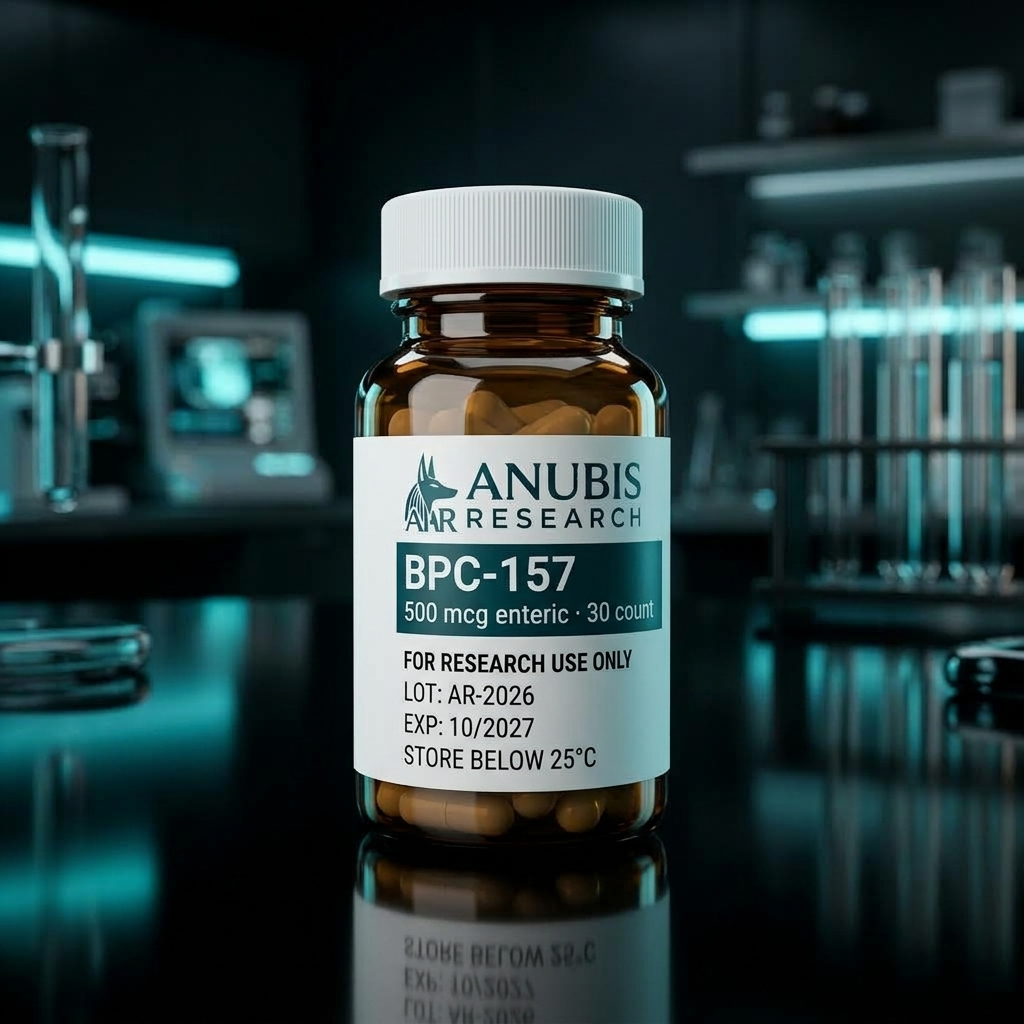
Research use only
BPC-157 Capsules (500mcg x 30 caps) research packaging
500mcg enteric-coated capsules, 30-count
Anubis Research Labs

Documentation

The certificate of analysis for the current lot (Lot BPC-CAP2025-09C) is sent on request, so you can review identity and purity testing before you order.

Request the lot COA

Research summary

BPC-157(Body Protection Compound-157, pentadecapeptide BPC 157)

Regulatory status
Not approved by the FDA for any use. FDA lists BPC-157 among substances that may present significant safety risks in compounding, citing possible immunogenicity and impurity concerns.
Strongest evidence
Mostly animal studies; human data limited to two small uncontrolled reports
Overview

BPC-157 is a synthetic 15-amino-acid peptide derived from a sequence found in a gastric protein. It is widely discussed for tissue repair, but almost all published evidence comes from animal and cell studies.

What researchers study it for
  • Tendon, ligament, muscle and bone healing (animal models)
  • Gastrointestinal injury models
  • Wound healing models
Mechanism

Reviews describe effects on angiogenesis (new blood-vessel growth), growth-hormone receptor expression and inflammatory cytokines in preclinical models. These mechanisms have not been confirmed in humans.

Evidence (5)
  1. Review

    Systematic review (HSS Journal, 2025)

    Of 36 eligible studies (1993-2024), 35 were preclinical and 1 was clinical. Preclinical models showed improved structural and biomechanical healing of muscle, tendon, ligament and bone. The authors found no clinical safety data.[1]

  2. Animal study

    Rat Achilles tendon (J Orthop Res, 2003)

    Faster healing of transected rat Achilles tendons; the same paper reports stimulated tendon-cell growth in culture.[2]

  3. Cells / in vitro

    Tendon fibroblasts (J Appl Physiol, 2011)

    Promoted outgrowth, survival and migration of tendon fibroblasts.[3]

  4. Human · small / uncontrolled

    Small human reports (2021, 2024)

    A retrospective phone survey of 16 knee-pain patients and a 12-patient pilot in interstitial cystitis, both from one private clinic, without control groups. Uncontrolled reports like these cannot separate a real effect from placebo or natural recovery.[4][5]

  5. Regulatory

    FDA compounding risk list

    Listed by FDA as a bulk substance that may present significant safety risks in compounding.[6]

Limitations of the evidence
  • No randomized human trial has been published.
  • A large share of the literature comes from a single research group; independent replication is limited.
  • Its use is prohibited in professional sport.
  • Human oral bioavailability of the capsule form is not established.
  • Products on this site are sold for laboratory research only. They are not the medicines used in the trials above, and those results do not apply to research material.
Questions researchers ask
Has BPC-157 been tested in people?
Only in two small, uncontrolled reports. A 2025 systematic review found no clinical safety data.
Why is it everywhere online, then?
Animal results are striking and widely shared. Reddit and forum reports are anecdotes: they are interesting context, not evidence of effect or safety.
Sources (7)

Reviewed 2026-10-02. Summaries describe published research and regulatory records; they are not medical advice and do not describe how to use this product. Sold for laboratory research use only.