Buy 5 or more, save 35% · code

Back to Catalog

Peptides

IGF-1 LR3 1 mg

$115Per Unit

83-amino acid polypeptide analog with 3-fold higher biological potency and significantly reduced binding to IGFBP-3. Sterile lyophilized research grade.

Lot IGF2026-12L · COA on request
Recombinant lyophilized analog, sterile vial, 1 mg fill
-20°C

1 × $115.00 = $115.00

4 more units of anything - mix and match - unlocks 35% off with code EHAB35.

IGF-1 LR3 1 mg

$115.00
Research use only
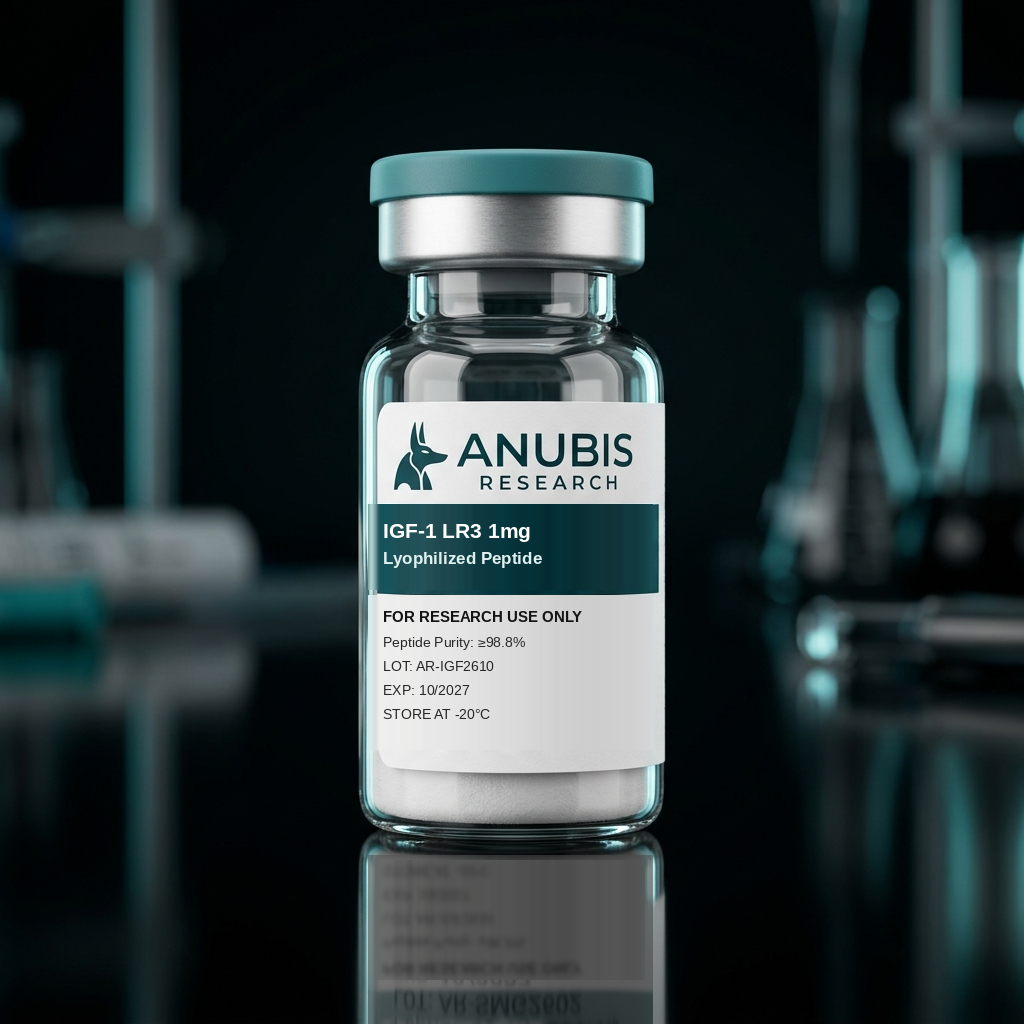
IGF-1 LR3 1 mg research packaging
Recombinant lyophilized analog, sterile vial, 1 mg fill
Anubis Research Labs

Documentation

The certificate of analysis for the current lot (Lot IGF2026-12L) is sent on request, so you can review identity and purity testing before you order.

Request the lot COA

Research summary

IGF-1 LR3(Long R3 IGF-I, LR3IGF-I, Long [Arg3]-IGF-I)

Regulatory status
Not an approved drug - a laboratory reagent. The FDA-approved IGF-1 medicine is mecasermin (Increlex, approved 2005), which is a different molecule.
Strongest evidence
Cell and animal studies only
Overview

IGF-1 LR3 is an engineered analog of human insulin-like growth factor-I: a 13-amino-acid extension at the start and arginine in place of glutamate at position 3. The changes leave it binding IGF-binding proteins very weakly, which made it more potent than IGF-I in many test systems.

What researchers study it for
  • IGF-I receptor and binding-protein research (cell studies)
  • Protein synthesis and breakdown in muscle cells
  • Growth and nitrogen retention in rats
Mechanism

It activates the IGF-I receptor. Because IGF-binding proteins barely hold it, more stays free to act - which is why it outperformed IGF-I in cells that secrete those binding proteins, but not in cells that do not.

Evidence (4)
  1. Cells / in vitro

    Design and potency (J Mol Endocrinol 1992)

    In rat muscle cells the Long IGF-I analogs were more potent than IGF-I at stimulating protein and DNA synthesis and slowing protein breakdown. Long [Arg3]-IGF-I was the most potent in cells that secrete IGF-binding proteins, and less potent than IGF-I in cells that do not.[1]

  2. Animal study

    Growth in rats (J Endocrinol 1993)

    Given to growing female rats for 14 days, it improved weight gain, nitrogen retention and feed efficiency as much as the highest IGF-I dose tested, at about one-sixth of that dose.[2]

  3. Product testing

    Black-market vial (Growth Horm IGF Res 2010)

    Doping-control analysis of a black-market injection vial found a His-tagged form of Long R3 IGF-I of the kind made for biochemical studies; the authors note its effects in humans have not been described.[3]

  4. Approved drug

    The approved IGF-1 medicine is a different molecule

    Mecasermin (Increlex), recombinant human IGF-1, was approved by the FDA on August 30, 2005. IGF-1 LR3 is not mecasermin.[4]

Limitations of the evidence
  • No human studies of IGF-1 LR3 were identified.
  • Products on this site are sold for laboratory research only. They are not the medicines used in the trials above, and those results do not apply to research material.
Questions researchers ask
Is IGF-1 LR3 the same as Increlex?
No. Increlex is mecasermin, recombinant human IGF-1. IGF-1 LR3 is a longer analog with an amino-acid change that alters how it binds IGF-binding proteins.
Sources (4)

Reviewed 2026-10-10. Summaries describe published research and regulatory records; they are not medical advice and do not describe how to use this product. Sold for laboratory research use only.