Buy 5 or more, save 35% · code

Back to Catalog

Small Molecules

Phenibut FAA (powder) – 50g

$56Per Unit

Free amino acid form phenibut with analytical verification for neuroscience research applications.

Lot PHE2025-12D · COA on request
50g bulk powder
Room temperature, dry location

1 × $56.00 = $56.00

4 more units of anything - mix and match - unlocks 35% off with code EHAB35.

Phenibut FAA (powder) – 50g

$56.00
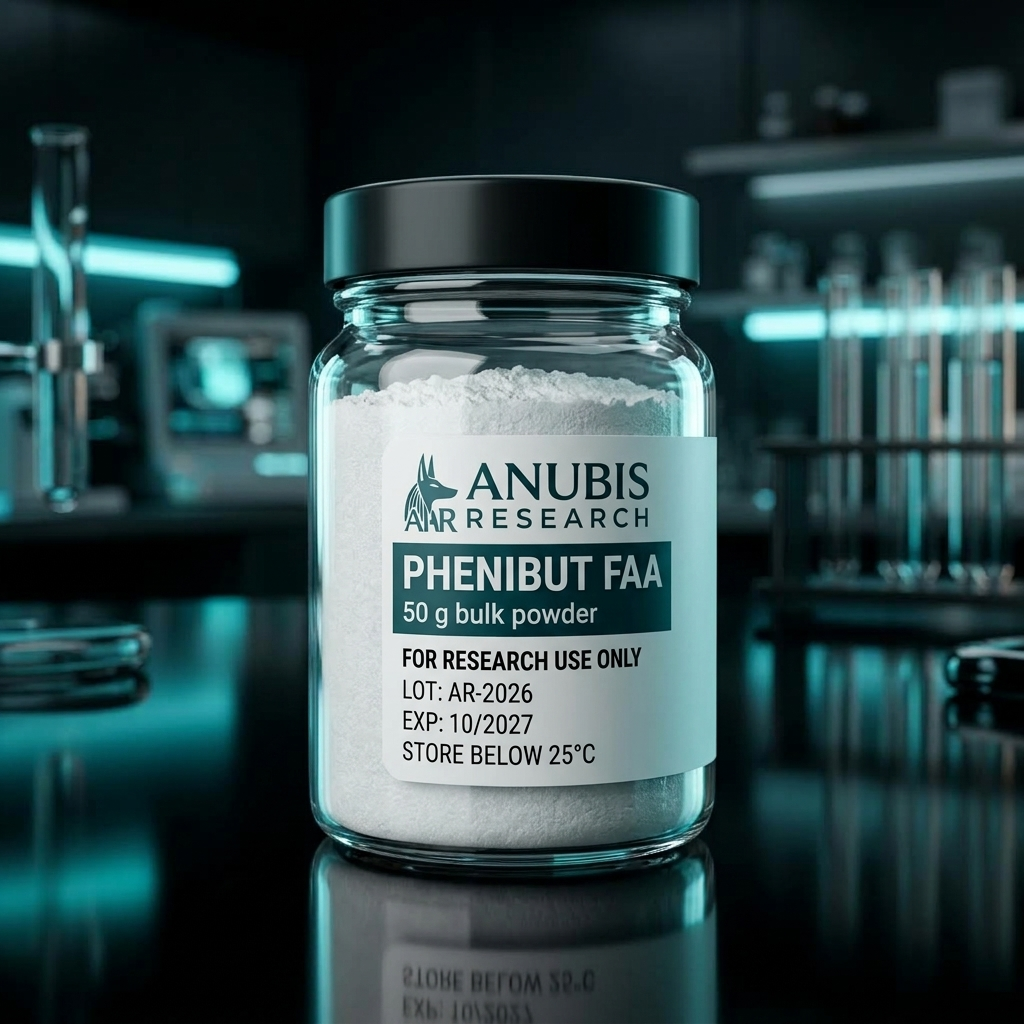
Research use only
Phenibut FAA (powder) – 50g research packaging
50g bulk powder
Anubis Research Labs

Documentation

The certificate of analysis for the current lot (Lot PHE2025-12D) is sent on request, so you can review identity and purity testing before you order.

Request the lot COA

Research summary

Phenibut(beta-phenyl-GABA, 4-amino-3-phenylbutyric acid, Phenibut FAA)

Regulatory status
Not approved in the United States. Used clinically in Russia since the 1960s. U.S. poison centers and published case reports document dependence and severe withdrawal.
Strongest evidence
Clinical use in Russia and receptor studies; U.S. data are poison-center reports and case reports
Overview

Phenibut is GABA with a phenyl ring attached, developed in Russia in the 1960s as an anti-anxiety and nootropic drug. It is a close structural relative of baclofen.

What researchers study it for
  • Anxiety, tension and sleep (clinical use in Russia)
  • GABA-B receptor pharmacology
  • Calcium-channel (α2-δ) binding and pain models in rats
  • Dependence and withdrawal (toxicology)
Mechanism

It acts mainly as a GABA-B receptor agonist. Its active R-form also binds the α2-δ subunit of voltage-dependent calcium channels - the gabapentin target - with about four times the affinity it has for GABA-B receptors.

Evidence (5)
  1. Review

    Pharmacology review (CNS Drug Rev 2001)

    Describes phenibut as a GABA-mimetic acting mainly at GABA-B receptors, used in Russia to relieve tension, anxiety and fear and to improve sleep.[1]

  2. Animal study

    α2-δ binding and pain models (Pharmacol Biochem Behav 2015)

    In rat brain tissue R-phenibut bound the gabapentin site on calcium channels, and in rat pain models it had gabapentin-like effects that a GABA-B blocker did not remove.[2]

  3. Human · small / uncontrolled

    U.S. poison centers 2009-2019 (MMWR 2020)

    1,320 phenibut exposures were reported from all 50 states and DC; 85% of calls came from health-care facilities. Cases rose sharply over the decade, especially after 2015, when poison centers could first log phenibut by name.[3]

  4. Review

    Withdrawal: systematic review (Clin Toxicol 2023)

    25 published cases of phenibut withdrawal: 44% were admitted to intensive care and 24% were intubated. Symptoms began as soon as two hours after the last use, and every published case of abrupt stopping was managed in hospital.[4]

  5. Product testing

    U.S. supplement testing (Neurol Clin Pract 2021)

    Detected among unapproved drugs in U.S. cognitive-enhancement supplements; several products contained drugs their labels did not declare.[5]

Limitations of the evidence
  • Human data are clinical experience from Russia, poison-center calls and case reports - not modern randomized trials.
  • Dependence and withdrawal are documented in the sources above.
  • Products on this site are sold for laboratory research only. They are not the medicines used in the trials above, and those results do not apply to research material.
Sources (5)

Reviewed 2026-10-10. Summaries describe published research and regulatory records; they are not medical advice and do not describe how to use this product. Sold for laboratory research use only.